

How Support Coordination Helps You Make the Most of Your NDIS
Updated: Sep 8
Having an NDIS plan doesn't automatically mean the right supports will fall into place.
At Joystep, we've met participants who had an NDIS plan for months but had barely used their funding. It wasn't because they didn't need support. Sometimes they didn't know where to start, couldn't find suitable providers, or weren't sure which services to organise first.
This is where Support Coordination can make a practical difference.
A Support Coordinator can help you turn the funding in your plan into supports that actually work in everyday life.

Your NDIS Plan Is Approved — What Happens Next?
Getting your plan approved is only the beginning. You may open your plan and see funding for therapy, community participation, assistive technology or other supports. But that doesn't necessarily answer practical questions such as:
Which support should I organise first?
How do I find the right provider?
What happens if there is a long waiting list?
How do all these services work together?
A Support Coordinator can help you work through these questions, prioritise what needs to happen and start putting the right supports in place.
Finding the Right Providers — Not Just Any Provider
Finding a provider online is easy. Finding one who actually suits you can be much harder.
For example, a participant may need a support worker for community access. But then the practical requirements start:
“I prefer a female worker.”
“I need someone who speaks Mandarin.”
“I'm only available on Wednesday afternoons.”
“I need someone experienced in supporting people with autism.”
A Support Coordinator can help identify suitable providers, check availability and compare different options.
When You Have Funding but Aren't Using It
Unused funding doesn't always mean the support wasn't needed.
We've seen participants come to Joystep with a significant amount of their plan still unused. In some cases, the family had struggled to find suitable providers. In others, they weren't sure what the funding could be used for or simply hadn't known how to get the services started.
That's an important distinction.
A Support Coordinator can look at what's currently in place, identify gaps and help work through barriers that may be stopping you from using your plan.
This is also why plan implementation matters when your next plan is considered. Current NDIS reporting requirements ask Support Coordinators to report on how a participant's plan has been implemented, the supports being used, progress towards goals and barriers that have affected progress.
When Your Supports Aren't Working Together
Many participants have more than one provider.
You might have an OT, physiotherapist, support workers, Plan Manager and other services involved at the same time.
The problem is that each provider may only see one part of the picture.
For example, your OT may recommend a new daily routine — but does your support worker understand how to follow it?
Your circumstances may have changed — but have the relevant providers been told?
A Support Coordinator can help keep the right people informed, identify gaps and make sure different supports aren't working in isolation.
That's the coordination part of Support Coordination.
Preparing for What Comes Next
Support Coordination isn't only about solving today's problems.
Over time, your coordinator should also help you understand:
which supports are working well
where there are gaps
whether your funding is being used as expected
what barriers have come up
whether your needs or circumstances have changed.
This becomes particularly useful when you're approaching your next NDIS Plan Reassessment.
Support Coordinator reporting can provide information about how your plan was implemented, what outcomes were achieved, barriers encountered and recommendations for future supports.
If your plan is coming up for reassessment, you can also read our guide on How to Prepare for an NDIS Plan Review.
Are You Making the Most of Your NDIS Plan?
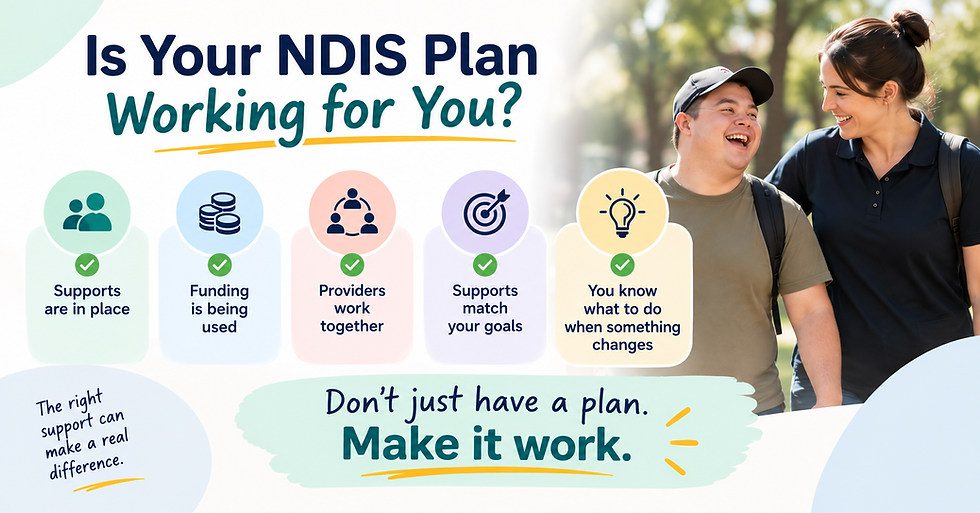
Ask yourself five simple questions:
Are the supports in my plan actually in place?
Am I using the funding I need?
Are my providers working well together?
Are my supports helping me work towards my goals?
Do I know what to do when something isn't working?
At Joystep, we focus on the practical side of Support Coordination — understanding what's happening now, identifying what's getting in the way and helping participants turn their NDIS funding into supports that work in everyday life.
Because having funding in your plan is one thing.
Making it work for you is what matters.
Related Service: Support Coordination
Related Reading:

Comments